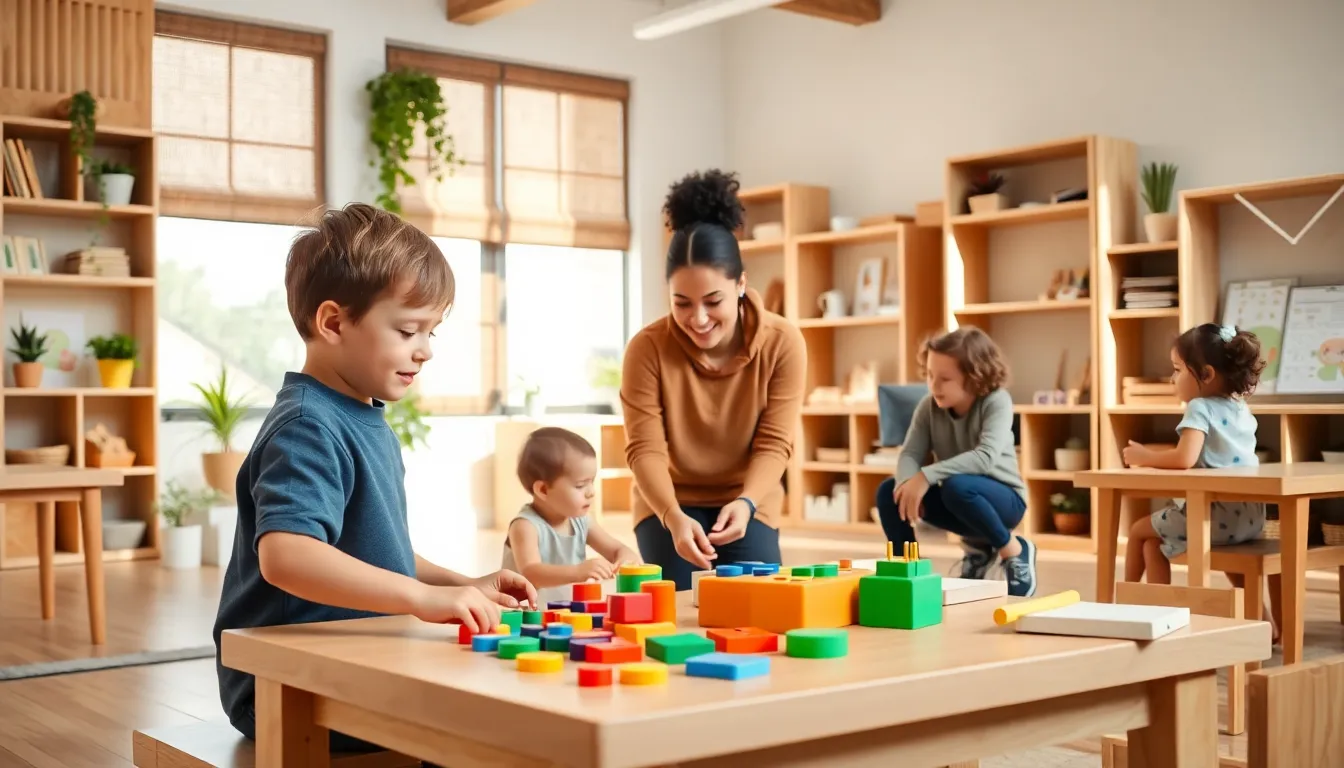
Montessori education has shaped how millions of children learn across the globe. Developed over a century ago, this method places the child at the center of every decision. Students choose their activities, set their pace, and explore subjects that spark genuine curiosity. Teachers act as guides rather than lecturers. Classrooms look different too, mixed-age groups, hands-on materials, and freedom of movement replace rows of desks and standardized lessons. Parents today often wonder if this approach fits their child’s needs. This article explains what Montessori education involves, its core principles, key benefits, and how it compares to traditional schooling.
Table of Contents
ToggleKey Takeaways
- Montessori education places children at the center, allowing them to choose activities, set their pace, and explore subjects based on genuine curiosity.
- Teachers in Montessori classrooms act as guides and observers rather than lecturers, preparing the environment and supporting each child’s individual journey.
- Mixed-age groupings (typically three-year spans) help younger students learn from older peers while older students reinforce knowledge through teaching.
- Key benefits of Montessori include independence, intrinsic motivation, stronger social skills, deep concentration, and improved executive function.
- Montessori differs from traditional education through student-led learning, observation-based assessment, longer uninterrupted work periods, and hands-on materials.
- Choosing Montessori depends on your child’s personality, your family values, and whether the approach aligns with how your child learns best.
What Is the Montessori Method?
The Montessori method is an educational philosophy created by Dr. Maria Montessori in Italy during the early 1900s. She was a physician who observed children closely and built her approach around their natural development.
Montessori classrooms operate on a few key ideas. Children learn best when they direct their own activities. They absorb information more effectively through hands-on experience than passive listening. And they develop at different rates, so rigid age groupings don’t serve everyone well.
In a Montessori setting, students typically work in three-year age spans. A classroom might include children ages 3 to 6 or 6 to 9. Younger students learn from older peers. Older students reinforce their knowledge by helping younger ones. This structure builds community and encourages collaboration.
Montessori materials are distinctive. They’re designed to be self-correcting, which means children can identify and fix their own mistakes without adult intervention. A puzzle piece that doesn’t fit, for example, signals an error immediately. This builds independence and problem-solving skills.
Teachers in Montessori schools don’t stand at the front of the room delivering lectures. They observe each child, introduce new materials when the student is ready, and step back to let learning happen. The teacher’s role is to prepare the environment and support, not control, the child’s journey.
Core Principles of Montessori Education
Several principles define how Montessori programs function. Understanding these helps parents and educators see why the method produces certain outcomes.
Respect for the Child
Montessori education treats children as capable individuals. Adults listen to their ideas, honor their choices, and avoid unnecessary interference. This respect fosters confidence and self-worth from an early age.
The Prepared Environment
Every Montessori classroom is carefully organized. Materials sit on low shelves where children can reach them. Furniture fits their size. The space invites exploration. Nothing is accidental, each element serves a purpose in supporting independent learning.
Auto-Education
Montessori believed children educate themselves when given proper resources and freedom. The teacher doesn’t transmit knowledge directly. Instead, the child absorbs it through interaction with materials and the environment. This concept, called auto-education, remains central to Montessori practice.
Sensitive Periods
Children pass through windows of intense interest in specific skills, language, order, movement, and sensory refinement, among others. Montessori educators watch for these sensitive periods and provide appropriate activities during them. Learning during these windows happens almost effortlessly.
Mixed-Age Groupings
Multi-age classrooms mirror real life. Children don’t interact only with same-age peers outside school, so why should they inside? Younger students gain role models. Older students develop leadership and teaching abilities. Everyone benefits from this social structure.
Benefits of a Montessori Learning Environment
Research and decades of classroom observation point to several advantages for children in Montessori programs.
Independence: Students make choices throughout their day. They select activities, manage their time, and care for their environment. These habits carry into adulthood.
Love of Learning: When children pursue interests freely, curiosity thrives. Montessori students often develop intrinsic motivation rather than relying on grades or rewards.
Social Skills: Mixed-age settings create natural opportunities for cooperation. Children practice conflict resolution, empathy, and communication daily.
Concentration: Montessori work periods typically last two to three hours without interruption. This extended time allows deep focus, a skill increasingly rare in a distracted world.
Academic Achievement: Studies have shown Montessori students perform as well as or better than peers in traditional schools on standardized tests. But the method emphasizes understanding over memorization, which may produce more lasting knowledge.
Executive Function: Research published in developmental psychology journals links Montessori education with stronger executive function skills, including planning, flexible thinking, and self-control. These skills predict success in school and beyond.
Not every child responds identically, of course. But for many, Montessori provides an environment where they flourish academically and personally.
How Montessori Differs From Traditional Education
Parents often ask how Montessori compares to conventional schooling. The differences are substantial.
| Aspect | Montessori | Traditional |
|---|---|---|
| Teacher Role | Guide and observer | Instructor and authority |
| Student Choice | High, children select activities | Low, curriculum is fixed |
| Pace | Individualized | Standardized for the group |
| Assessment | Observation-based, no grades in early years | Tests and letter grades |
| Classroom Setup | Mixed ages, hands-on materials | Same-age groups, desks in rows |
| Work Periods | Long, uninterrupted blocks | Short periods divided by bells |
In traditional classrooms, the teacher determines what happens and when. Everyone studies the same subject at the same time. Montessori flips this model. The child’s readiness and interest drive the schedule.
Assignments looks different too. Many Montessori schools assign little or no assignments, especially in early grades. They believe the school day provides sufficient learning time when used effectively.
Grading is another distinction. Younger Montessori students don’t receive letter grades. Teachers assess progress through observation and detailed reports. This removes the pressure of competition and keeps focus on actual learning.
Neither approach is universally superior. Some children thrive with more structure. Others blossom when given freedom. The right choice depends on the individual child and family values.
Is Montessori Right for Your Child?
Choosing an educational path requires honest reflection. Montessori works beautifully for many children, but it’s not a perfect fit for everyone.
Consider your child’s personality. Does your child enjoy making choices and working independently? Montessori provides that freedom. Does your child need clear boundaries and direct instruction to feel secure? A more traditional setting might serve them better.
Think about your own values too. Montessori families often prioritize independence, creativity, and intrinsic motivation over grades and test scores. If academic rankings matter most to you, understand that Montessori schools may not emphasize them, at least in the early years.
Visit local Montessori programs before deciding. Watch how teachers interact with students. Notice whether children seem engaged or restless. Ask about teacher training, authentic Montessori educators complete specialized certification programs.
Cost is practical consideration as well. Many Montessori schools are private, though public Montessori options exist in some districts. Investigate what’s available in your area and what fits your budget.
Finally, trust your instincts. You know your child better than anyone. If a Montessori classroom feels right during your visit, that intuition matters.