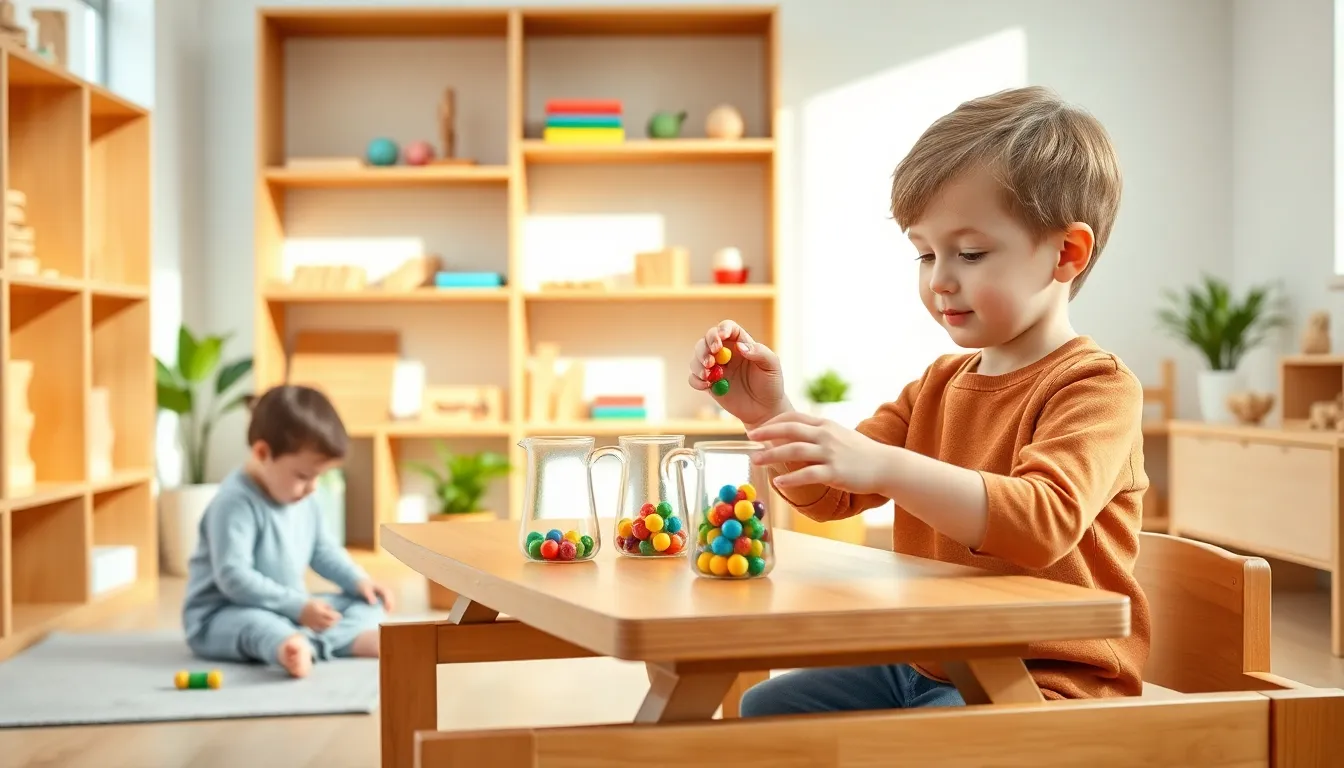
Montessori examples show how children learn through hands-on activities and self-directed exploration. Parents and educators often search for concrete ways to apply the Montessori method in classrooms and at home. This approach, developed by Dr. Maria Montessori over a century ago, remains popular because it works. Children gain independence, develop problem-solving skills, and build confidence through carefully prepared environments. This article presents specific Montessori examples across different settings and age groups. Readers will discover practical activities they can carry out today.
Table of Contents
ToggleKey Takeaways
- Montessori examples include practical life activities like pouring, buttoning, and food preparation that build independence and fine motor skills in young children.
- Sensorial materials such as the Pink Tower and Color Tablets help children refine their senses while preparing them for later academic concepts.
- Parents can apply Montessori at home by creating accessible spaces with low shelves, child-height hooks, and self-care stations that encourage independence.
- The Montessori method features child-led learning, mixed-age groupings, and uninterrupted work periods that allow deep engagement with activities.
- Montessori examples vary by age—from black-and-white mobiles for infants to independent research projects for elementary students—respecting each developmental stage.
- Research shows Montessori students demonstrate stronger academic and social outcomes compared to peers in traditional classroom settings.
What Is the Montessori Method?
The Montessori method is an educational approach that emphasizes child-led learning within a structured environment. Dr. Maria Montessori developed this system in Italy during the early 1900s after observing how children naturally learn through play and exploration.
Several core principles define this approach:
- Prepared environment: Teachers arrange classrooms with age-appropriate materials at child height. Everything has a specific place.
- Mixed-age groupings: Children typically learn in groups spanning three years. Older students help younger ones, reinforcing their own knowledge.
- Uninterrupted work periods: Students choose activities and work on them for extended periods, usually two to three hours.
- Hands-on materials: Concrete objects help children understand abstract concepts. They touch, move, and manipulate learning tools.
- Teacher as guide: Adults observe and offer support rather than direct instruction. They introduce materials and step back.
Montessori examples demonstrate these principles in action. A child might spend 45 minutes working with counting beads, completely absorbed. Another might practice pouring water between pitchers, a simple task that builds concentration and motor skills.
The method works because it respects children’s natural development. Kids don’t sit passively receiving information. They actively construct knowledge through experience. Research supports this approach. A 2017 study published in Frontiers in Psychology found that Montessori students showed stronger academic and social outcomes compared to peers in traditional classrooms.
Montessori Classroom Examples
Montessori classrooms look different from traditional schools. Visitors notice children working independently at low tables or on floor mats. They see shelves lined with beautiful materials in wooden trays. The room feels calm, purposeful.
These Montessori examples represent what happens in authentic programs.
Practical Life Activities
Practical life activities form the foundation of Montessori education, especially for children ages three to six. These exercises mirror real household tasks.
Common Montessori examples include:
- Pouring: Children transfer rice, beans, or water between containers. This builds hand control and concentration.
- Buttoning and zipping: Dressing frames let kids practice fastening clothing. They gain independence in self-care.
- Food preparation: Students slice bananas, spread butter, or wash vegetables. They learn sequencing and fine motor control.
- Cleaning: Sweeping, dusting, and washing tables teach responsibility. Children take pride in maintaining their space.
- Plant care: Watering plants and tending gardens connects kids to nature. They observe growth cycles firsthand.
These activities seem simple. That’s the point. Young children crave real work. They want to participate in adult life. Practical life exercises satisfy this need while building essential skills.
Sensorial Materials
Sensorial materials help children refine their five senses. Dr. Montessori designed these tools to isolate specific qualities, size, color, weight, temperature, or sound.
Popular Montessori examples include:
- Pink Tower: Ten pink cubes increase in size. Children stack them from largest to smallest, developing visual discrimination and understanding of dimension.
- Brown Stair: Similar to the Pink Tower, these rectangular prisms vary in width. Kids arrange them in sequence.
- Color Tablets: Boxes contain colored tablets in pairs. Children match identical colors, then later arrange shades from lightest to darkest.
- Sound Cylinders: Paired containers produce different sounds when shaken. Students match cylinders by the noise they make.
- Geometric Solids: Wooden shapes, spheres, cones, cubes, pyramids, let children explore three-dimensional forms through touch.
These materials prepare children for later academic work. A child who masters the Pink Tower understands graduated sizes. This prepares them for mathematical concepts. Sensorial work also builds vocabulary as teachers introduce precise terms like “thick,” “thin,” “rough,” and “smooth.”
Montessori Examples at Home
Parents don’t need special training or expensive materials to apply Montessori principles at home. Simple adjustments create an environment that supports independence and learning.
Effective Montessori examples for home include:
Kitchen setup: Place child-safe dishes on low shelves. Let kids pour their own water from a small pitcher. Provide a learning tower so they can help with cooking. Even toddlers can wash lettuce or stir batter.
Accessible clothing: Store everyday clothes in low drawers or bins. Let children choose their outfits. Use hooks at child height for coats and bags.
Self-care stations: Set up a low sink or step stool in the bathroom. Provide a small mirror, hairbrush, and toothbrush within reach. Children as young as two can manage basic hygiene tasks with minimal help.
Toy rotation: Keep only a few toys available at once. Store the rest and rotate them monthly. This reduces overwhelm and encourages deeper engagement with each item.
Nature activities: Collect leaves, rocks, or shells during walks. Sort them at home by color, size, or type. Plant seeds in small pots and track their growth.
Reading spaces: Create a cozy corner with books displayed cover-out on low shelves. Children select their own reading material. This encourages independence and builds a love of books.
The key? Observe the child. Notice what interests them. A kid fascinated by bugs might enjoy a magnifying glass and insect identification cards. One who loves music benefits from simple instruments arranged on an accessible shelf.
Montessori at home doesn’t require perfection. It requires intention. Small changes, a hook at kid height, a step stool in the kitchen, make big differences.
Montessori Examples by Age Group
Montessori education spans from birth through adolescence. Each stage features different materials and activities suited to children’s developmental needs.
Infants (0-12 months)
Montessori examples for babies focus on movement and sensory exploration:
- Black and white mobiles for visual tracking
- Wooden rattles and grasping toys
- Floor time on movement mats
- Simple board books with real images
- Treasure baskets filled with safe household objects
Toddlers (1-3 years)
This period emphasizes language development and gross motor skills:
- Object-to-picture matching games
- Simple puzzles with knobs
- Push and pull toys
- Basic pouring and transferring activities
- Stacking and nesting toys
- Language cards with real photographs
Primary (3-6 years)
The classic Montessori classroom serves this age group. Montessori examples include:
- Sandpaper letters for pre-reading
- Moveable alphabet for spelling
- Golden beads for understanding place value
- Metal insets for handwriting preparation
- Geography puzzles with continents and countries
- Botany and zoology materials
Elementary (6-12 years)
Older children engage with abstract concepts through stories and research:
- Great Lessons (cosmic education stories about universe, life, humans)
- Timeline of life and civilization studies
- Advanced math materials like the checkerboard
- Independent research projects
- Community service and “going out” experiences
Montessori examples shift as children grow. Younger kids need concrete, hands-on experiences. Older students handle increasingly abstract material while maintaining that signature hands-on approach. The method scales beautifully across ages because it respects developmental stages rather than arbitrary grade levels.