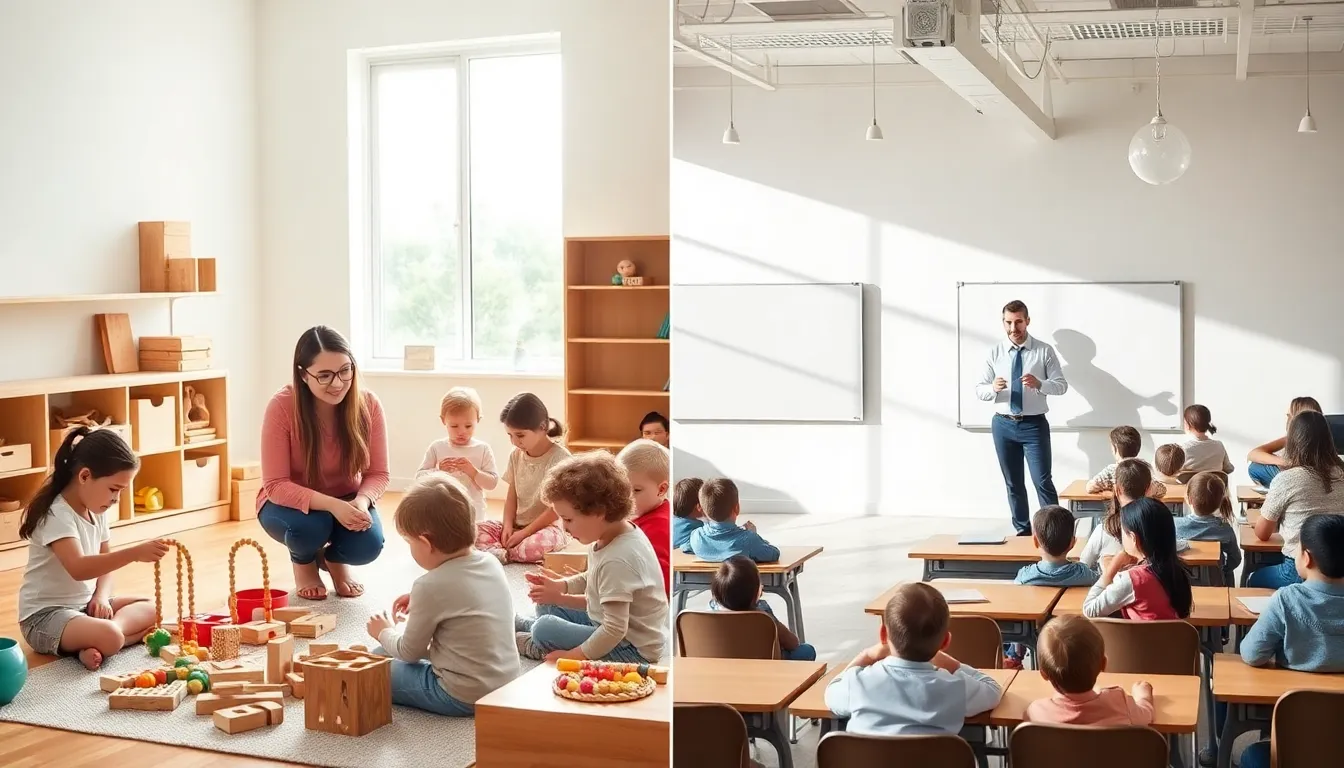
Montessori vs traditional education, it’s a decision that keeps many parents up at night. Both approaches have shaped millions of young minds, but they operate on fundamentally different principles. One puts the child in the driver’s seat: the other follows a more structured, teacher-led path. Neither is universally “better.” The right choice depends on a child’s learning style, personality, and family values. This guide breaks down the key differences between Montessori and traditional education, examines the pros and cons of each, and offers practical advice for making this important decision.
Table of Contents
ToggleKey Takeaways
- Montessori vs traditional education comes down to your child’s learning style, personality, and family values—not which method is objectively better.
- Montessori emphasizes child-led, hands-on learning with mixed-age groups, while traditional education follows a structured, teacher-centered approach with same-age classes.
- Montessori schools can cost $10,000–$30,000 annually, whereas traditional public schools are widely available and free.
- Self-directed, curious children often thrive in Montessori settings, while kids who prefer clear instructions and routines may do better in traditional classrooms.
- Visit schools, observe classrooms, and talk to current parents before making your Montessori vs traditional decision.
- The choice isn’t permanent—children can switch educational approaches if the first choice doesn’t work out.
What Is Montessori Education?
Montessori education is a child-centered teaching method developed by Dr. Maria Montessori in the early 1900s. It emphasizes independence, hands-on learning, and self-directed activity.
In a Montessori classroom, children choose their own activities from a range of options the teacher prepares. They work at their own pace, often in mixed-age groups. A five-year-old might sit next to a three-year-old, both working on different tasks suited to their development.
The teacher acts as a guide rather than a lecturer. They observe each child, introduce new materials when appropriate, and step back to let learning happen naturally. Classrooms feature specialized Montessori materials, wooden blocks, bead chains, sandpaper letters, designed to teach specific concepts through touch and manipulation.
Montessori vs traditional settings differ sharply here: there are no grades, no assignments in early years, and no standardized tests. Progress is measured through observation and portfolio assessments. The philosophy trusts that children have an innate desire to learn and will thrive when given freedom within structure.
What Is Traditional Education?
Traditional education follows a teacher-centered model. The teacher stands at the front of the classroom, delivers lessons, and students learn the same material at the same time.
This approach groups children by age. A typical second-grade class contains only seven- and eight-year-olds. Students sit at desks arranged in rows, follow a set curriculum, and complete assignments on the teacher’s schedule.
Grades and standardized tests measure progress. Assignments reinforces classroom lessons. The structure is predictable: bells ring, subjects change, and everyone moves together through the school year.
Traditional education has deep roots. It’s the system most parents experienced themselves. Schools use textbooks, worksheets, and direct instruction. Teachers explain concepts, demonstrate skills, and assess understanding through quizzes and exams.
When comparing Montessori vs traditional approaches, the traditional model prioritizes consistency and clear benchmarks. It prepares students for standardized academic environments they’ll encounter later in life.
Core Differences Between Montessori and Traditional Approaches
The Montessori vs traditional debate centers on several key distinctions:
Learning Style
Montessori encourages exploration. Children pick their activities and work until satisfied. Traditional education assigns tasks and expects completion within set timeframes.
Teacher’s Role
Montessori teachers observe and guide. Traditional teachers instruct and direct. One facilitates discovery: the other delivers knowledge.
Classroom Setup
Montessori classrooms feature low shelves, open floor space, and activity stations. Traditional classrooms have desks in rows facing a whiteboard or blackboard.
Assessment Methods
Montessori uses observation and developmental checklists. Traditional education relies on grades, tests, and report cards.
Social Structure
Montessori mixes ages, encouraging older children to mentor younger ones. Traditional schools separate students by birth year.
Pace of Learning
Montessori allows each child to advance when ready. Traditional education moves the whole class forward together, regardless of individual mastery.
These differences in Montessori vs traditional methods reflect deeper philosophical beliefs about how children learn best.
Pros and Cons of Each Method
Montessori Advantages
- Fosters independence and self-motivation
- Respects individual learning speeds
- Develops strong problem-solving skills
- Creates a love of learning through choice
- Builds social skills across age groups
Montessori Disadvantages
- Can be expensive (private Montessori schools cost $10,000–$30,000 annually)
- Less structure may frustrate some children
- Transition to traditional schools can be difficult
- Fewer schools available in many areas
- Inconsistent quality, not all “Montessori” schools follow authentic methods
Traditional Education Advantages
- Widely available and often free through public schools
- Clear expectations and measurable outcomes
- Prepares students for standardized testing
- Familiar structure most families understand
- Easier transitions between schools
Traditional Education Disadvantages
- One-size-fits-all approach doesn’t suit every learner
- Less room for creativity and exploration
- Can discourage intrinsic motivation
- Faster learners may feel bored: slower learners may feel left behind
The Montessori vs traditional choice isn’t about which method is superior. It’s about which method fits a particular child’s needs.
How to Choose the Right Fit for Your Child
Choosing between Montessori vs traditional education requires honest assessment of a child’s personality and learning style.
Consider Montessori if a child:
- Shows strong curiosity and self-direction
- Works well independently
- Gets restless sitting still for long periods
- Learns best through hands-on activities
- Benefits from moving at their own pace
Consider traditional education if a child:
- Thrives with clear instructions and routines
- Enjoys group activities and structured schedules
- Responds well to external motivation like grades
- Prefers knowing exactly what’s expected
- Adapts easily to authority-led environments
Practical steps parents can take:
- Visit schools. Observe classrooms in action. Watch how teachers interact with students.
- Talk to current parents. Ask about their experiences, good and bad.
- Consider logistics. Factor in cost, location, and schedule.
- Trust instincts. Parents know their children. If something feels off during a visit, it probably is.
Some families find hybrid options work best. Certain schools blend Montessori principles with traditional structure. Others homeschool using Montessori materials at home.
The Montessori vs traditional decision doesn’t have to be permanent. Children can switch if the first choice doesn’t work out.