Finding the best Montessori school for a child requires more than a quick Google search. Parents want a program that honors their child’s natural curiosity while building real academic skills. The Montessori method has grown from a single classroom in Rome to over 20,000 schools worldwide, but not all programs deliver the same quality.
This guide breaks down what separates exceptional Montessori schools from average ones. Parents will learn the key features that define a quality program, practical ways to evaluate local options, and the exact questions to ask during school visits. Whether a family is new to Montessori or switching from a traditional school, this information helps them make a confident choice.
Table of Contents
ToggleKey Takeaways
- The best Montessori schools feature trained teachers with AMI or AMS credentials, authentic Montessori materials, and uninterrupted work periods of 2–3 hours.
- Look for mixed-age classrooms, child-accessible materials on open shelves, and low student-to-teacher ratios (around 10–12 students per teacher).
- Schedule classroom observations during regular work periods to see if children are engaged, purposeful, and choosing activities freely.
- Ask about teacher training, curriculum approach, discipline methods, and how the school prepares children for transitions to other educational settings.
- Check for accreditation from AMI or AMS as a starting point, but also talk to current families for honest perspectives on the program.
- The best Montessori school balances quality education with practical factors like location, tuition, and schedule that fit your family’s needs.
What Makes a Montessori School Stand Out
The best Montessori schools share certain qualities that set them apart from both traditional classrooms and weaker Montessori programs. Understanding these distinctions helps parents spot the difference quickly.
Child-Centered Learning Environment
A standout Montessori school puts children in charge of their learning. Students choose their own activities from a prepared environment. Teachers observe and guide rather than lecture. This approach builds independence and internal motivation, skills that serve children throughout their lives.
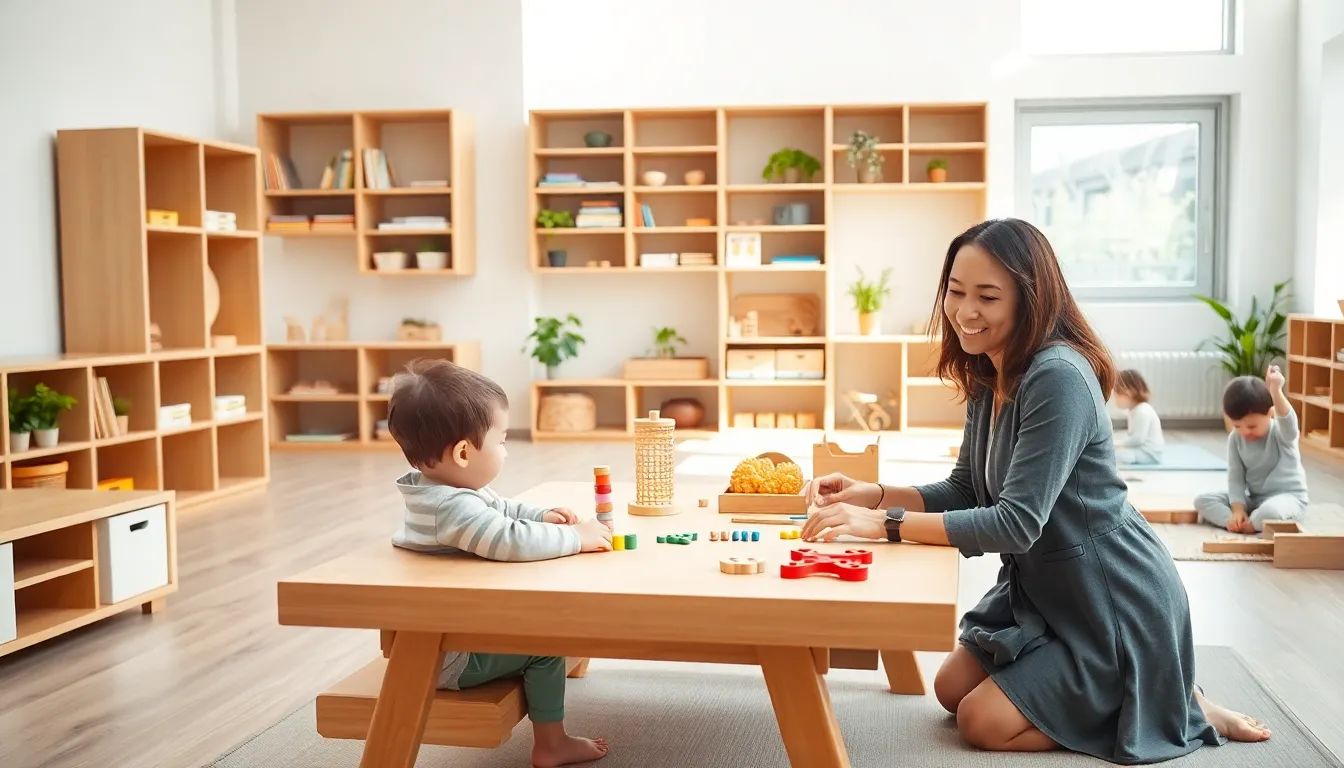
Classrooms in top Montessori schools look different from traditional settings. Children work at tables or on floor mats instead of desks in rows. Materials sit on open shelves at child height. Mixed-age groupings (typically spanning three years) allow younger children to learn from older peers while older students reinforce their knowledge through teaching.
Authentic Montessori Materials
The best Montessori programs use authentic, high-quality materials designed by Maria Montessori herself. These aren’t random toys or worksheets. Each material teaches a specific concept through hands-on exploration. The Pink Tower builds understanding of dimension. The Moveable Alphabet introduces reading and writing. Golden Beads make abstract math concepts concrete.
Schools that cut corners often substitute cheaper alternatives. Parents should look for classrooms equipped with genuine Montessori materials, a sign that the school invests in proper implementation.
Trained and Credentialed Teachers
Teacher training matters enormously in Montessori education. The best Montessori schools employ teachers with credentials from recognized training centers like AMI (Association Montessori Internationale) or AMS (American Montessori Society). These programs require hundreds of hours of coursework, observation, and supervised practice.
A credentialed Montessori teacher knows how to present each material, when to intervene, and when to step back. They understand child development at a deep level. This expertise separates authentic Montessori education from programs that simply borrow the name.
Key Features to Look for in a Quality Montessori Program
Parents searching for the best Montessori school should evaluate several specific features. These elements indicate whether a program truly follows Montessori principles.
Uninterrupted Work Periods
Quality Montessori programs schedule uninterrupted work blocks of at least two to three hours. Children need this time to choose activities, concentrate deeply, and complete their work without constant transitions. Schools that chop the day into short segments undermine the entire approach.
During these work periods, children move freely around the classroom. They might spend 45 minutes on a math material, then shift to practical life activities. This freedom within structure defines the Montessori experience.
Prepared Environment
The classroom itself teaches in a Montessori school. The best Montessori programs maintain beautiful, orderly spaces with natural materials and soft colors. Everything has a designated place. Children can access materials independently and return them when finished.
Look for classrooms organized into distinct areas: practical life, sensorial, language, math, and cultural studies. Each area contains a progression of materials from simple to complex. This organization allows children to follow their interests while building skills systematically.
Low Student-to-Teacher Ratios
Even the best Montessori curriculum fails without adequate staffing. Quality programs maintain low ratios, typically one trained teacher for every 10 to 12 students, with assistant teachers providing additional support. This allows teachers to observe each child, present new materials individually, and respond to emerging needs.
Strong Parent Communication
Top Montessori schools keep parents informed without overwhelming them. They offer regular conferences, classroom observations, and clear explanations of the curriculum. Parents should understand what their child is learning and why. Schools that operate as black boxes raise red flags.
How to Evaluate Montessori Schools in Your Area
Finding the best Montessori school nearby requires active research. Parents shouldn’t rely on marketing materials alone. Here’s a practical evaluation process.
Start with Accreditation
Check whether schools hold accreditation from recognized Montessori organizations. AMI and AMS accreditation indicates that programs meet established standards. These organizations conduct site visits and review curricula, teacher credentials, and classroom environments.
But, accreditation isn’t everything. Some excellent schools lack formal accreditation, while some accredited programs have weaknesses. Use accreditation as a starting point, not the final word.
Schedule Classroom Observations
The best Montessori schools welcome parent observations. Spending an hour or two watching a classroom in action reveals more than any brochure. Parents should observe during a regular morning work period, not during special events or assemblies.
During the observation, notice whether children seem engaged and purposeful. Are they choosing activities freely? Do teachers give individual presentations rather than whole-group instruction? Is the classroom calm but active? These signs indicate authentic Montessori practice.
Talk to Current Families
Current parents provide honest perspectives that schools won’t always share. Ask about their child’s experience, teacher responsiveness, and any concerns. Find out how long families typically stay enrolled. High turnover might signal problems.
Many schools can connect prospective families with current parents. If a school refuses this request, consider it a warning sign.
Consider Practical Factors
The best Montessori school academically might not fit a family’s practical needs. Location, hours, tuition, and schedule all matter. A wonderful program two hours away serves no one. Parents should create a shortlist based on quality, then narrow it by logistics.
Questions to Ask During Your School Visit
A school visit gives parents direct access to administrators and teachers. Asking the right questions separates serious candidates from poor fits. Here are essential questions for evaluating the best Montessori options.
About Teacher Training
- Where did your lead teachers receive their Montessori training?
- What ongoing professional development do teachers complete?
- How long have your teachers been with the school?
Answers reveal whether the school prioritizes qualified staff. Teacher turnover also matters, high turnover disrupts children’s learning and suggests workplace problems.
About the Curriculum
- How do you handle children who struggle with certain concepts?
- What does a typical day look like?
- How do you assess student progress without traditional grades?
Strong Montessori programs track progress through observation and individual benchmarks rather than standardized tests in early years. Teachers should articulate clear learning goals for each age group.
About Classroom Practice
- How long are uninterrupted work periods?
- What is your approach to discipline?
- How do you handle transitions to elementary school or traditional schools?
The best Montessori schools prepare children for any educational path. They should explain how students develop skills that transfer to other settings.
About Parent Involvement
- How often do you communicate with parents about progress?
- Can parents observe classrooms regularly?
- What opportunities exist for parent education about Montessori methods?
Schools confident in their approach welcome parent involvement. Programs that discourage observation or limit communication may have something to hide.